
By Rittal on Jul 7, 2026, 1:00:01 AM
As Australia's critical infrastructure becomes increasingly distributed, more electrical and automation equipment is being deployed beyond traditional control rooms. From utilities, transport, and water infrastructure to mining operations, renewable energy sites, and telecommunications networks, equipment is now routinely installed in remote and exposed environments where reliability is essential.
As a result, the role of the outdoor enclosure has evolved. While protection from dust and water ingress remains fundamental, today's infrastructure requires enclosure systems that also support thermal management, future expansion, equipment longevity, and simplified maintenance.
Outdoor Conditions Demand More Than a High IP Rating
Outdoor infrastructure is routinely exposed to harsh environmental conditions. Dust, humidity, UV radiation, heavy rainfall, coastal corrosion, vibration, and significant temperature fluctuations all place additional stress on electrical equipment.
Selecting an enclosure is no longer simply about achieving a particular IP rating. Internal operating conditions are equally important, particularly as enclosure-mounted equipment becomes more sophisticated.
Modern outdoor installations commonly house PLCs, communications equipment, power supplies, variable speed drives, network devices, monitoring systems, and automation hardware. Together, these components generate heat that must be effectively managed to maintain long-term performance and reliability.
Thermal Performance is a Design Consideration
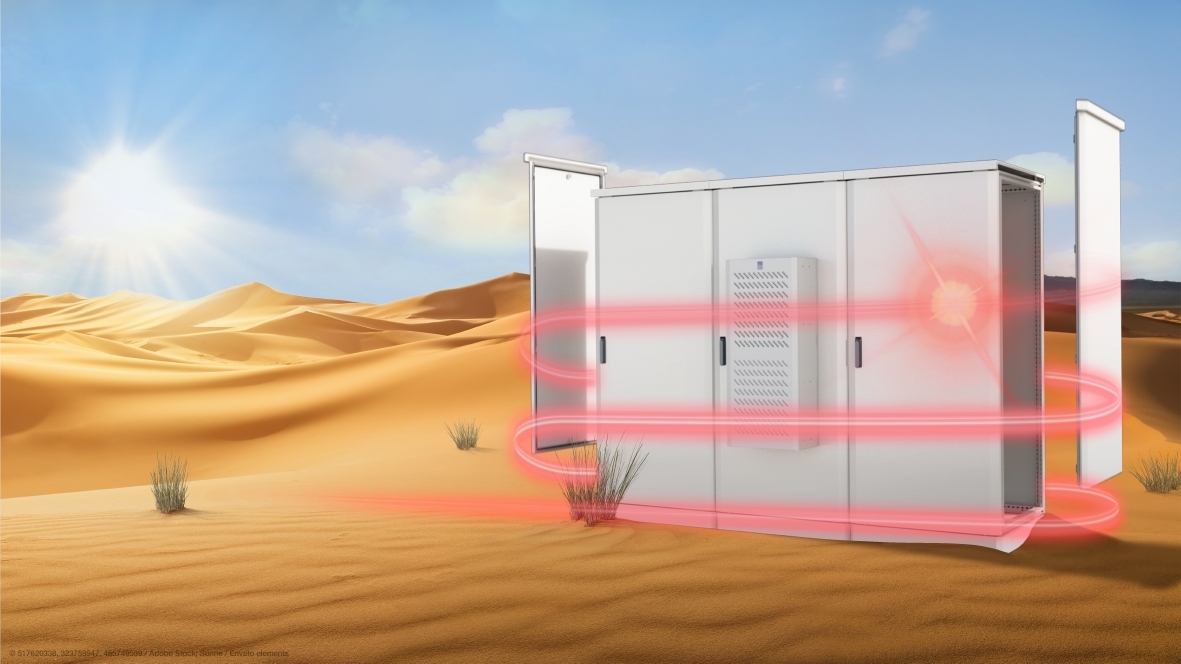
Managing solar heat gain and internally generated heat loads has become an important part of enclosure specification.
Double-walled enclosure systems are specifically designed to reduce heat transfer from direct sunlight while maintaining more stable internal operating temperatures. By creating an air gap between the external enclosure wall and internal equipment, thermal loads can be significantly reduced before active cooling is required.
Rittal's CS Toptec outdoor enclosure platform incorporates this double-walled construction together with integrated airflow paths that create a natural chimney effect, assisting passive heat dissipation.
Where higher thermal loads exist, climate control solutions can be incorporated into the enclosure. Cooling requirements can be accurately modelled using thermal calculation software such as RiTherm, allowing enclosure performance to be matched to both environmental conditions and actual equipment heat loads.
Designing for Infrastructure That Evolves
Critical infrastructure rarely remains unchanged throughout its service life.
Additional communications equipment, monitoring systems, automation devices, and power distribution components are frequently added as operational requirements evolve.
For this reason, scalability should be considered during enclosure selection. Modular, bayable enclosure systems provide the flexibility to expand existing installations without replacing the original enclosure.
The CS Toptec platform supports this approach through a modular architecture that allows multiple enclosure sections to be combined as infrastructure requirements grow.
Improving Serviceability Through Digital Documentation
As infrastructure networks become larger and more geographically dispersed, efficient access to technical information is increasingly important.
Digital documentation platforms enable engineers and maintenance personnel to access wiring diagrams, service records, and technical documentation directly from the enclosure, removing the reliance on paper-based information that can become outdated or misplaced.
Solutions such as Rittal ePOCKET link documentation directly to the enclosure via a QR code, ensuring the latest project information is always available at the point of maintenance.
Designing for Long-Term Reliability
The demands placed on outdoor infrastructure continue to increase as industries adopt greater levels of automation, digital monitoring, and remote operation.
While ingress protection remains an important consideration, today's enclosure systems must also deliver thermal performance, modular scalability, serviceability, and long-term durability.
Outdoor enclosure platforms such as Rittal's CS Toptec demonstrate how enclosure design has evolved beyond basic environmental protection. By combining robust construction, passive and active thermal management, modular expansion capability, and digital documentation tools, they provide a complete infrastructure solution for critical outdoor applications.
As more essential infrastructure moves beyond the control room, enclosure design is becoming an increasingly important component of long-term asset protection and operational reliability.
Learn more about Rittal Outdoor Enclosure Solutions:
https://www.rittal.com/au-en/au/LandingPages/Rittal-Outdoor-Solutions-Brochure